
By Ines Aviles-Spadoni, M.S., M.A., Research & Communications Coordinator
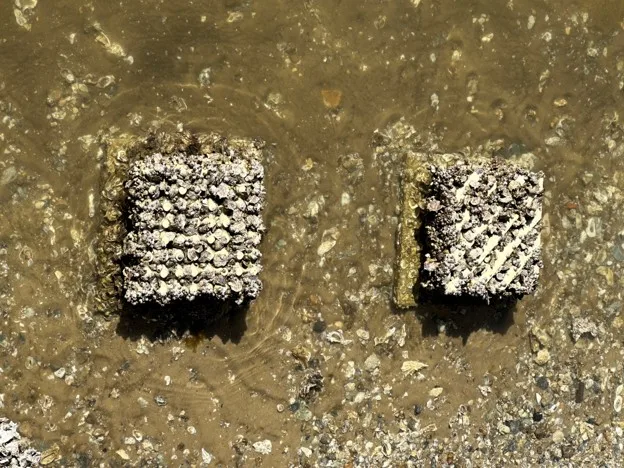
Imagine building a coastal structure that protects shorelines and grows stronger over time as nature takes over.
Instead of a lifeless barrier, oysters and other marine life gradually start to grow on it, helping absorb wave energy and creating a healthy habitat that will eventually protect the shoreline.
That is the goal of a University of Florida-led project titled Architected Materials for Extreme Resistance in Coastal Applications (AMERICA). The project’s principal investigator is Xiao Yu, Ph.D., an associate professor in the Department of Civil and Coastal Engineering and associate director of the Center for Coastal Solutions (CCS). At the center of this project are Nature-Inspired Architected Coastal Resilient Ecostructures (NACRE), 3D-printed coastal structures designed to provide immediate shoreline protection while also allowing nature to take root over time.
“The hybrid NACRE blends the strength of engineered infrastructure with the regenerative power of nature-based solutions, and solves climate challenges while restoring valuable ecosystems,” Yu said.
Coastal communities have traditionally relied on gray infrastructure such as seawalls and breakwaters to protect shorelines. These systems do provide immediate protection but can have adverse effects on marine habitats in the area. Nature-based solutions, including oyster reefs and living shorelines, help restore marine ecosystems but can take years before they provide full protection. NACRE hopes to address this gap by providing protection from wave energy from the start while giving oysters and other marine organisms time to colonize the structures.
The AMERICA project also works closely with coastal communities to get their input since they are the ones directly affected by coastal erosion. The researchers are working with them to understand their priorities before deciding how the technology will be designed and implemented. By working directly with communities, the researchers are designing solutions with communities and not just simply for them.
That’s where Savanna Barry, Ph.D., comes in. Barry is a regional specialized extension agent for coastal ecosystems with UF’s Institute of Food and Agricultural Sciences Sea Grant program. She leads the project’s community engagement efforts and the NACRE testing. She is based at the Nature Coast Biological Station in Cedar Key, Florida.

“As an extension agent, my role is to help bring university science out into communities and help it make its way into real-world applications,” Barry said.
Barry said her role is to help engineers on the team better understand the real-world practitioner’s needs and interests. That perspective helps to inform much of her work in Cedar Key and in other areas of Florida, where she helps address increasing coastal erosion as sea level rise and storms become more frequent and intense. She said coastal communities are seeing fast rates of shoreline erosion on top of historic losses in marshlands and oyster habitats.
One way to think about NACRE is as an apartment building for oysters. Instead of creating one solid block of material, the researchers are adding a variety of openings, channels, and surfaces that are textured where oyster larvae can settle in and thrive. As the oysters grow, they create a natural reef that absorbs wave impact and where other marine life will eventually settle in.
The prototypes being tested at Cedar Key are 3D-printed from a calcium carbonate material. This material is comparable to the material found in limestone and seashells. The team chose Cedar Key to test NACRE because of its long history of community involvement in shoreline projects and partnerships, and because the surrounding waters have abundant oyster larvae.
Early results show oysters already settling and growing on the NACRE structures. This is important because it shows the structures could be used to create reefs. Data collection from those tests will help in further refining future design of the structure.
“The idea is to help engineers understand what practitioners want to know about new materials before they try them out in real life,” Barry said. “And so basically, we’re working on doing some tests alongside more established known materials to try to help understand things like price point, deployment costs, and oyster recruitment ability.”
While the first phase of the AMERICA project focuses on oyster reefs and shoreline protection, the 3D technology could be used for a variety of coastal applications such as living breakwaters, erosion control, and retrofitting larger offshore infrastructure.
“NACRE’s success will spark a paradigm shift in resilient coastal communities strategy with climate-adaptive, hybrid regenerative 3D-printed coastal infrastructure,” Yu said.