
By Ines Aviles-Spadoni, M.S., M.A., Research & Communications Coordinator
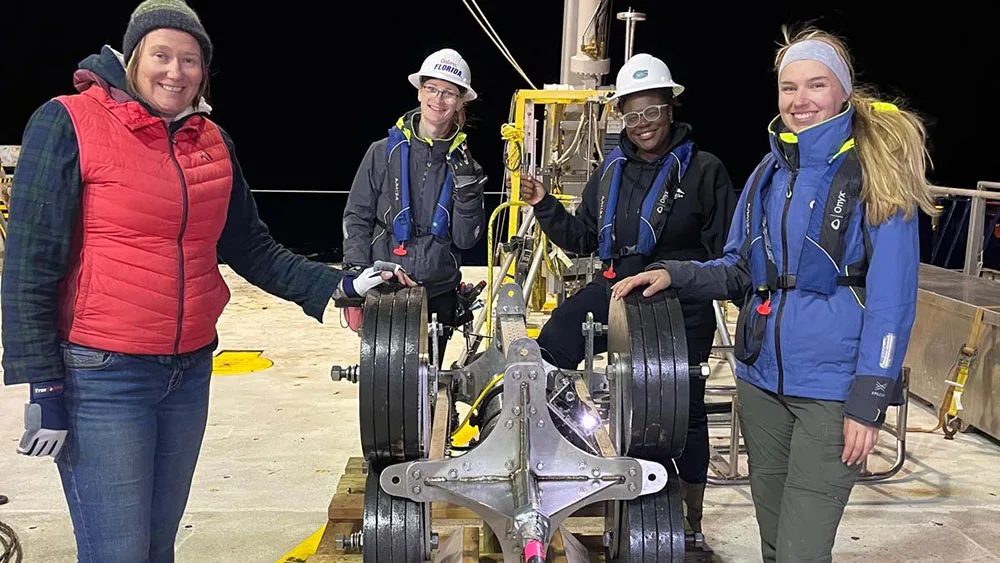
Lea Eggensberger said that to understand the type of sediment lying at the bottom of a body of water, sometimes you have to poke it. That’s a very simple way of describing how the modular penetrometer, or ModPen, works.
The ModPen is a tool developed by University of Florida coastal geotechnics Professor Nina Stark, Ph.D. and her team at the Department of Civil and Coastal Engineering and through support from the Office of Naval Research.
“It’s an instrument that you lower to the seabed, and then you basically poke the ground,” said Eggensberger, who is working on her doctoral degree under Stark’s guidance. “As you poke it, the instrument is taking measurements.”
For Eggensberger, ModPen represents a great opportunity to build on her own background in geology and marine geosciences. The instrument allows her to investigate how sediments change from shallow to deeper waters and is now part of her doctoral research.
So, what does the ModPen look like and how does it work? It has a cone-shaped tip that measures the resistance and friction that it encounters as it penetrates, or “pokes,” the sediment at the bottom of a body of water, as well as the pressure around it. In the seabed, this pressure is known as pore pressure. The measurements help researchers understand sediment types and how they behave in response to loads and stresses. This information is especially important for any civil engineering or naval applications with contact to the seabed.
ModPen was developed to conduct unique measurements of seabed sediments ranging from shallow waters down to the deep sea. During some recent testing, it broke its own previous water depth record for the deepest measurement taken with a free-fall penetrometer, where it successfully collected data at depths of 9,000 feet.
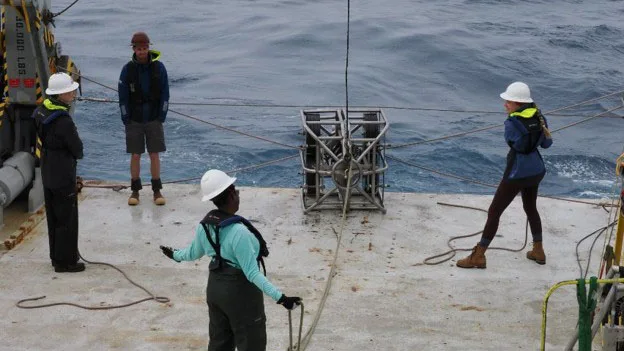
The development of the ModPen involved a team effort. Research Coordinator Charli Pezoldt worked with Jack Parker, a former UF technical staff at the Center for Coastal Solutions (CCS), during the instrument’s development. They helped Stark with the assembly and with testing. Today, Pezoldt oversees all modifications and maintenance to the ModPen and travels with the instrument to different research vessels and field sites to support operations and maintenance.
Another doctoral student is also assisting with this project. Her name is Arianna Martin. She helps to assemble and prepare ModPen for deployment, but much of her work occurs after the instrument is pulled back up from the water.
“Mostly processing the data and ensuring that the data makes sense, ensuring that we’re able to actually read what is coming out of the cone, if that data is correct and interpreting it,” Martin said.
Martin focuses her research on understanding how worms and other lifeforms living in the seabed change the conditions of seabed sediments and affect different engineering properties.
The ModPen is on the path to becoming a benchmark instrument, leading the research community towards investigating the geomechanics of seabed sediments from the coast to the deep sea.