
By Megan Sam
Coastal residents in Juno Beach know firsthand how much their shoreline is changing. Stronger storms, recurring flooding and harmful algal blooms have become familiar challenges, and many community members are eager for solutions that don’t just describe the problems — but help them prepare for what’s ahead. That desire for practical answers filled the room at Loggerhead Marinelife Center on October 15, where 93 residents gathered for a By the Sea lecture highlighting how the University of Florida’s Center for Coastal Solutions (UF CCS) is working directly with communities to build resilience at a time when hurricanes and rising seas dominate local concerns.
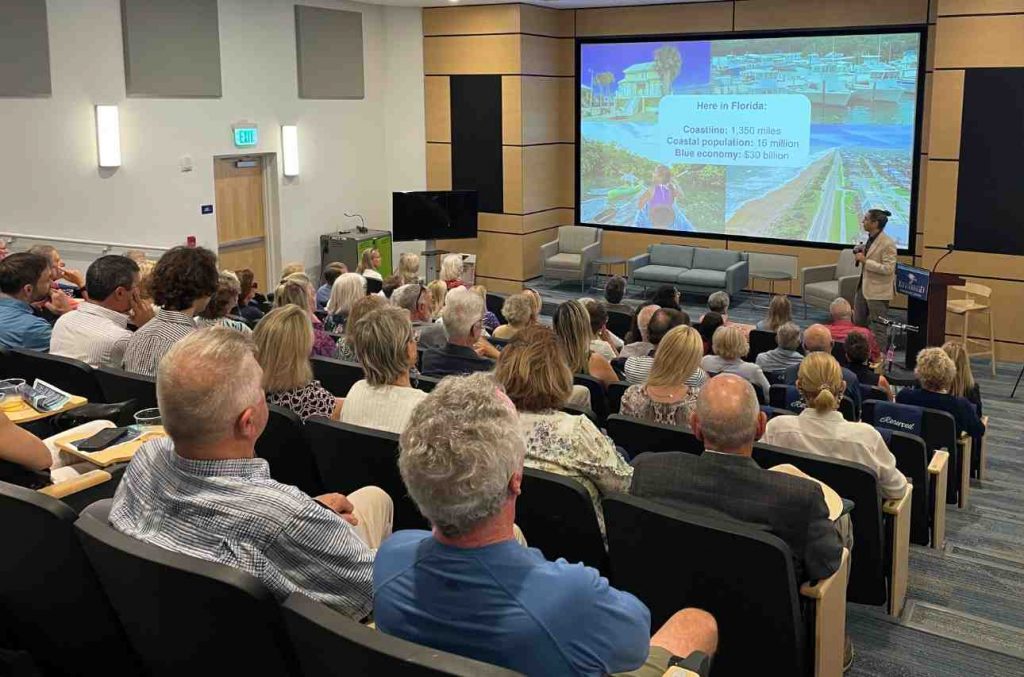
“CCS implements solutions-based research that solves the real-world problems facing our coastlines today,” Heather Barron, Ph.D., chief science officer and lead veterinarian at Loggerhead Marinelife Center, said. “While it’s important to understand the problems facing us here in coastal Florida, it’s uplifting to know that there are scientists coming up with options that are outcome-driven and give us a viable path forward.”
Britney Hay, a graduate student in environmental engineering sciences at UF and CCS student affiliate, began by connecting directly to the concerns of local residents.
“Juno Beach sits on Florida’s east coast, an area vulnerable to hurricanes,” Hay said. “Our research focuses on the hazards residents here know well — storms, flooding and algal blooms — and on strategies to address them.”
Hay then described a promising restoration technique being tested in St. Augustine: adding a thin layer of sediment to eroded marshes to help them keep up with rising sea levels. By testing different types and thicknesses of sediment on black mangroves and smooth cordgrass — two key wetland plants in the area — she found that the right combination can help salt marshes recover and even grow stronger. Her results suggest that this method has real potential for protecting vulnerable wetlands across Florida, including in communities like Juno Beach.
From there, CCS Interim Director Andrew Altieri, Ph.D., shared how the center’s research is helping communities prepare on multiple fronts. He pointed to advances in hurricane and algal bloom forecasting that provide earlier and more reliable warnings. Altieri also highlighted the team’s Engineering With Nature® work, which strengthens dunes by harnessing natural processes, such as the ways different coastal plant species support each other to speed up restoration and build more resilient shorelines.
“Our goal is to give coastal communities practical, science-based tools to live more safely and sustainably with nature,” Altieri said.
The event drew strong interest from city leaders excited to learn how these solutions could help their communities.
“After the lecture, I was thrilled to hear from city leaders who said they were eager to try some of the Engineering With Nature® strategies to improve dune resilience,” Barron, who is also a CCS advisory board member, said.